

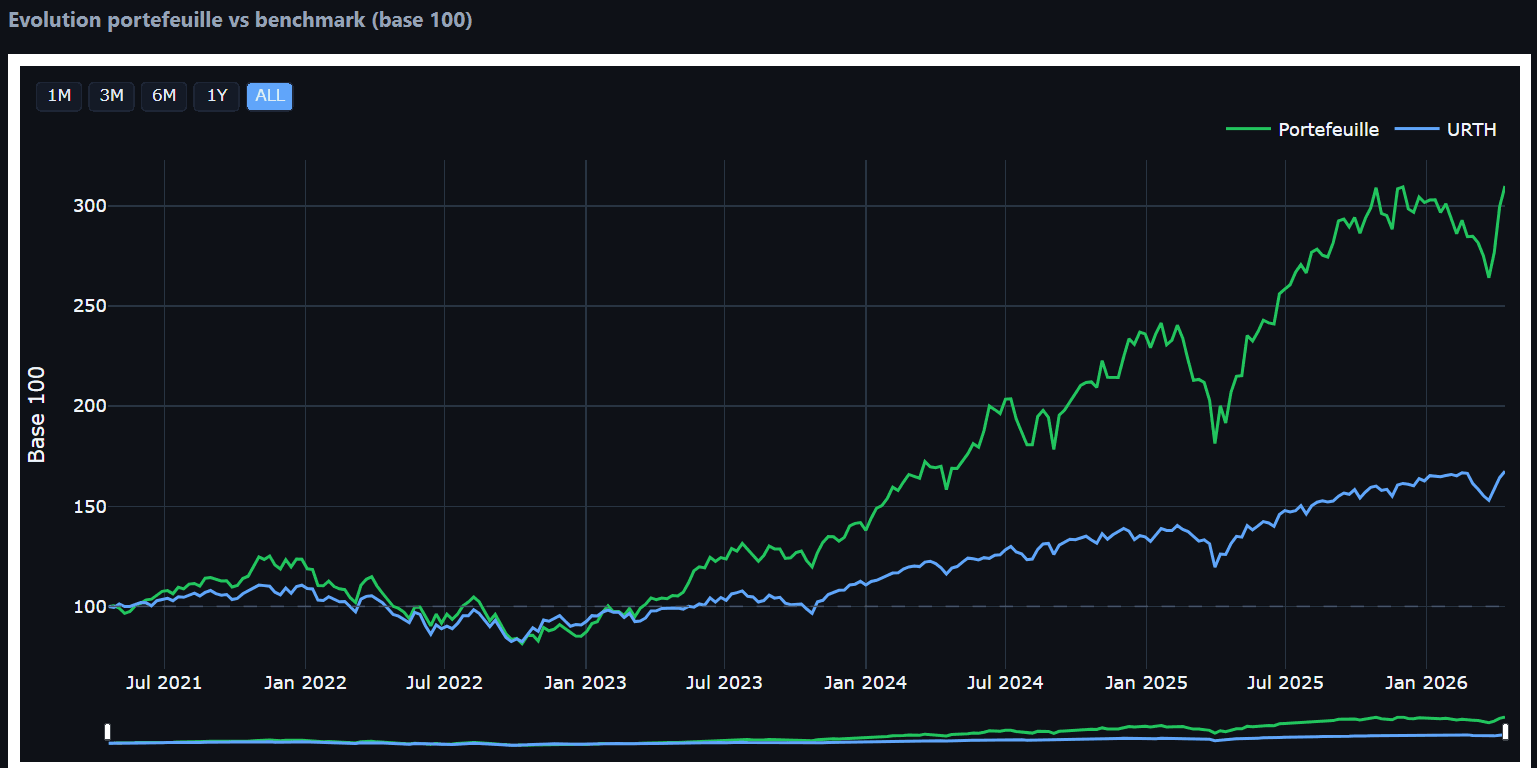
Comparison of several strategy performance paths over a five-year period.
Quantitative Finance · Analysis · Python
This project is directly linked to the wealth-tracking application: backtest and simulation outputs help guide allocation decisions inside the main portfolio workflow. It aims to build an analysis environment that can test several investment approaches across multiple assets, compare their performance, and study the risk or return profile of a portfolio. The project follows a practical quantitative-finance logic: clean data, explicit assumptions, comparable metrics, and readable visual outputs.
What this project demonstrates
Ability to structure a backtesting engine, compare several allocations under a common framework, and add Monte Carlo analysis to assess the distribution of possible portfolio paths.
My role
I defined the assumptions, collected and cleaned market data, implemented the backtests, built the Monte Carlo simulation layer, computed the metrics, and interpreted the results from a financial perspective.
Context
I wanted to complement academic market-finance training with a tool built end to end. The goal was to test investment hypotheses, compare outputs, and interpret performance, volatility, drawdown, diversification, and robustness more concretely.
Objective
Build an analysis framework that can compare several strategies, visualize their outputs, run scenario simulations through Monte Carlo, and assess portfolio robustness across several metrics.
Demo
Deep dive
This module is the quantitative engine behind the wealth-tracking stack: it backtests allocations, measures their risk and return profile, and adds Monte Carlo simulations to test path robustness.
Gallery
Comparison of several strategy performance paths over a five-year period.
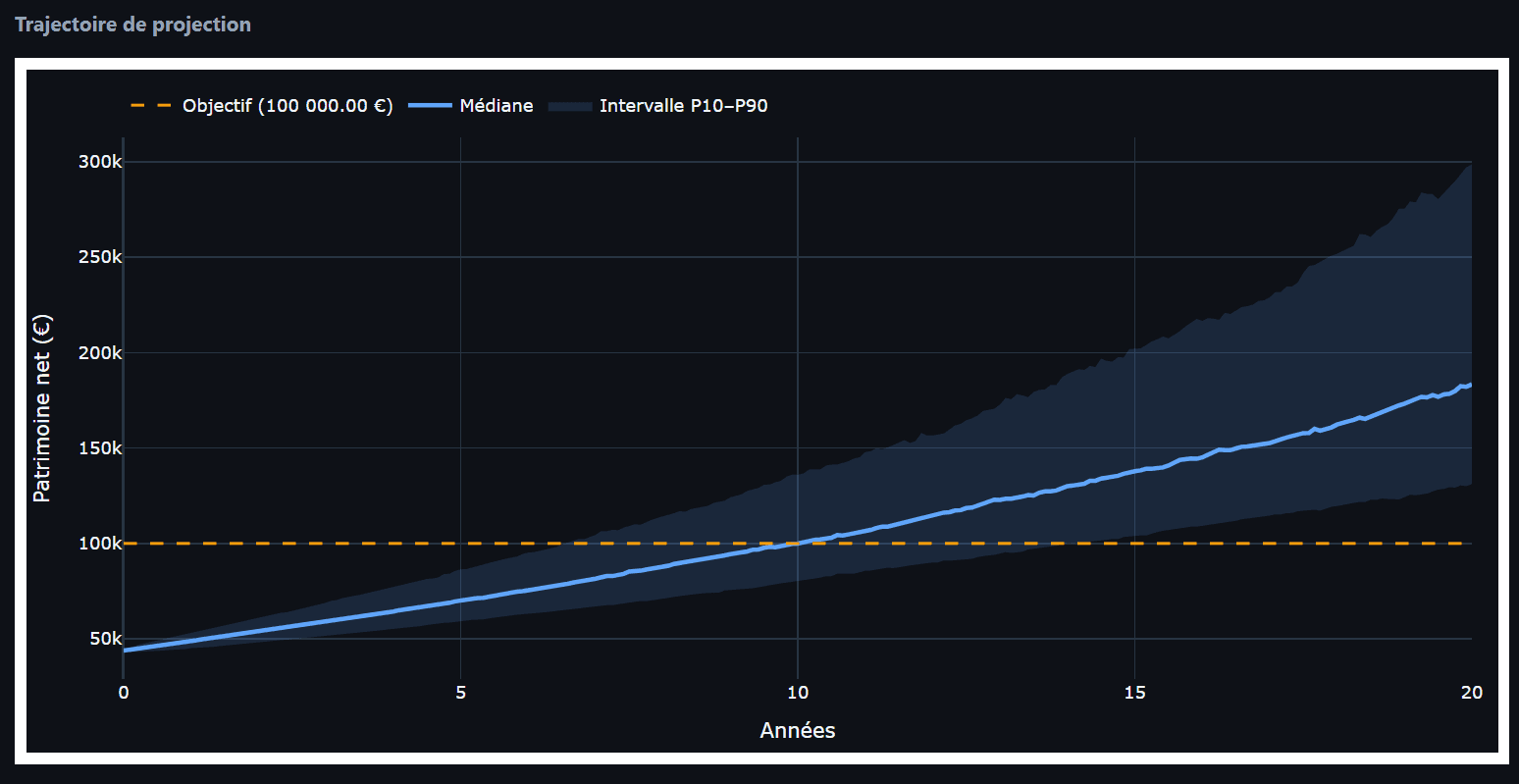
Monte Carlo projection used to visualize the dispersion of portfolio scenarios.
Architecture
Preparation of price and return series, cleaning of missing quotes, and time alignment to ensure consistent comparisons.
Execution of parameterized strategies with allocation rules, rebalancing logic, horizon, and constraints, while keeping a full portfolio-value history.
Monte Carlo path generation based on historical returns to assess the range of possible outcomes.
Generation of KPIs and comparative visuals such as cumulative performance, drawdown, and trajectory dispersion to support allocation decisions.
Pipeline
Technical choices
Strategies are evaluated with the same dataset, the same periods, and the same calculation conventions to limit comparison bias.
The evaluation combines performance and risk through volatility, drawdown, and Sharpe so conclusions are not driven by raw return alone.
The simulations are meant to measure uncertainty and dispersion, not to predict the future with precision.
The most robust scenarios are fed back into the broader allocation logic used in the wealth-tracking project.
Reliability
Limitations
Roadmap
Challenges
Design a unified framework that can compare very different strategies such as buy and hold, weighted allocations, and periodic rebalancing under the same assumptions.
Integrate Monte Carlo outputs in a readable way without overstating their predictive power.
Preserve a clear separation between raw data, calculation logic, visual reporting, and interpretation so the pipeline remains maintainable.
Outcomes and learnings
Reproducible five-year backtests to compare strategies and allocations.
Standardized reading of risk and return metrics, including annualized performance, volatility, drawdown, Sharpe, and relative stability.
Monte Carlo module added to visualize likely portfolio paths and quantify uncertainty around historical results.
Analysis base reused by the wealth-tracking project to connect operational monitoring with allocation decisions.
Other projects
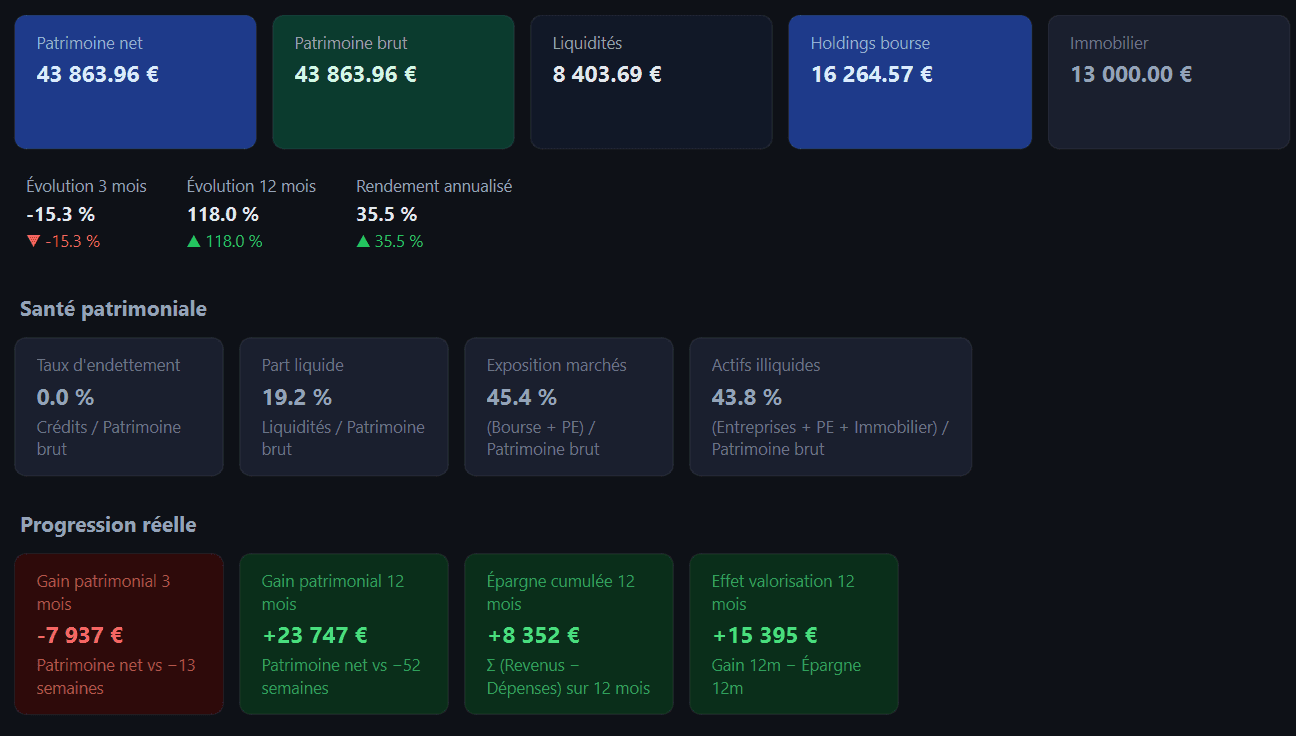
Personal Finance · Python · PyQt6
PyQt6 + SQLite desktop application to centralize multi-asset accounts, rebuild weekly history, and analyze portfolio performance.
View this project
Quantitative Finance · C++ · Pricing
Group project in C++ to price several option types, including European, American, and Asian contracts, with CRR, Black-Scholes, and Monte Carlo.
View this projectDiscuss
If this project is relevant for you, I can detail the initial need, data structure, assumptions, challenges encountered, and analysis limitations.