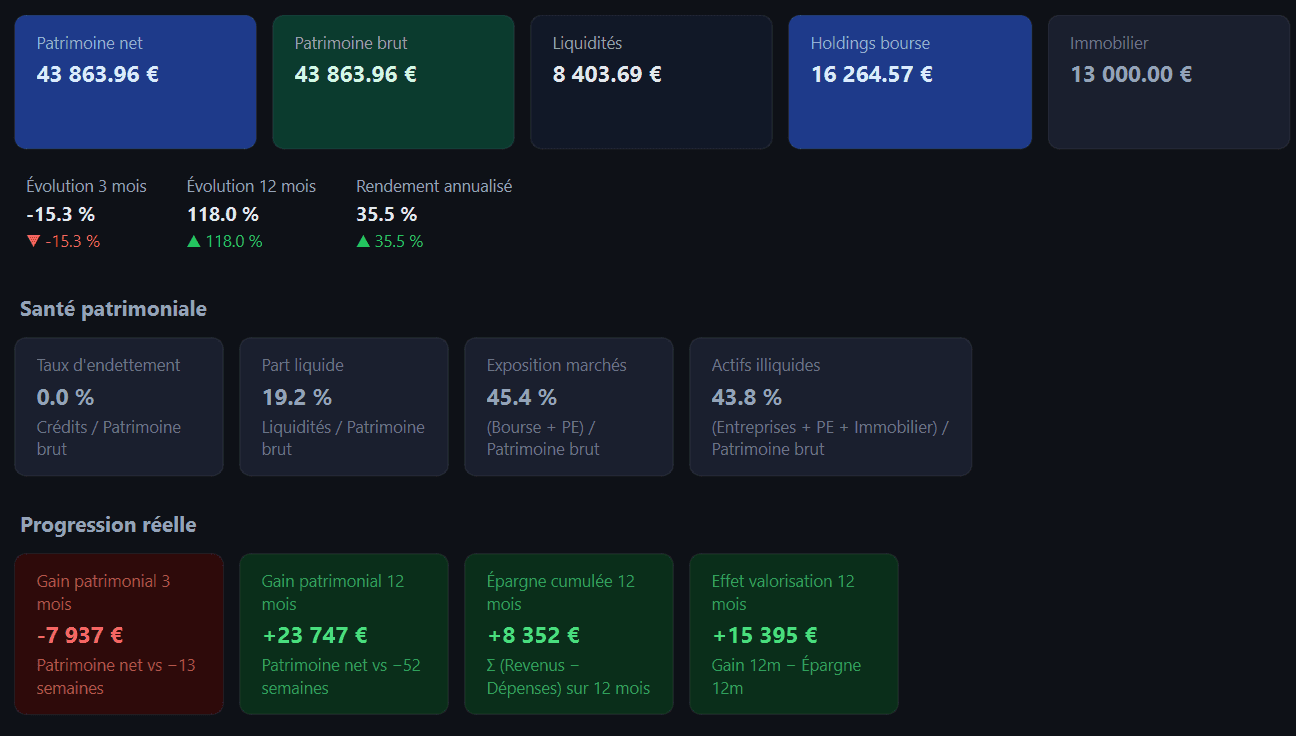
Consolidated KPI view of wealth and core portfolio metrics.
Personal Finance · Python · PyQt6
This project is directly linked to the portfolio backtesting and optimization module: simulation outputs are reused here to support broader wealth analysis. It is a Python desktop application for personal wealth monitoring built around a modular architecture with service layers, a Qt interface, and an SQLite database. The application aggregates transactions across several account types (bank, savings, PEA/CTO, private equity), normalizes the data, and produces weekly snapshots to track wealth over time. The analytics layer computes risk and return metrics with proper cash-flow neutralization and FX handling. The application also includes a Trade Republic import flow with alias mapping (symbols/ISIN), data-quality checks, and full household-history rebuilds from the first transaction onward.
What this project demonstrates
Ability to build a complete financial tool: data modeling, transaction ingestion and normalization, advanced portfolio analytics, desktop UI, and testing discipline.
My role
I designed the architecture, implemented the business services and SQLite layer, built the Qt screens for dashboards, imports, and controls, and expanded the portfolio metrics with a strong focus on data quality.
Context
The initial need was to replace fragmented tracking based on spreadsheets and manual exports with a single robust system capable of handling multiple asset classes, several accounts, and a long history with retroactive corrections.
Objective
Build a reliable base for wealth tracking and portfolio analysis: allocation, performance, net cash flows, passive income, historical rebuilds, and simulation or optimization modules that support decision-making.
Demo
Deep dive
The project works as a wealth-tracking engine: transaction ingestion, accounting normalization, weekly snapshots, and portfolio analytics built for decision support.
Gallery
Consolidated KPI view of wealth and core portfolio metrics.
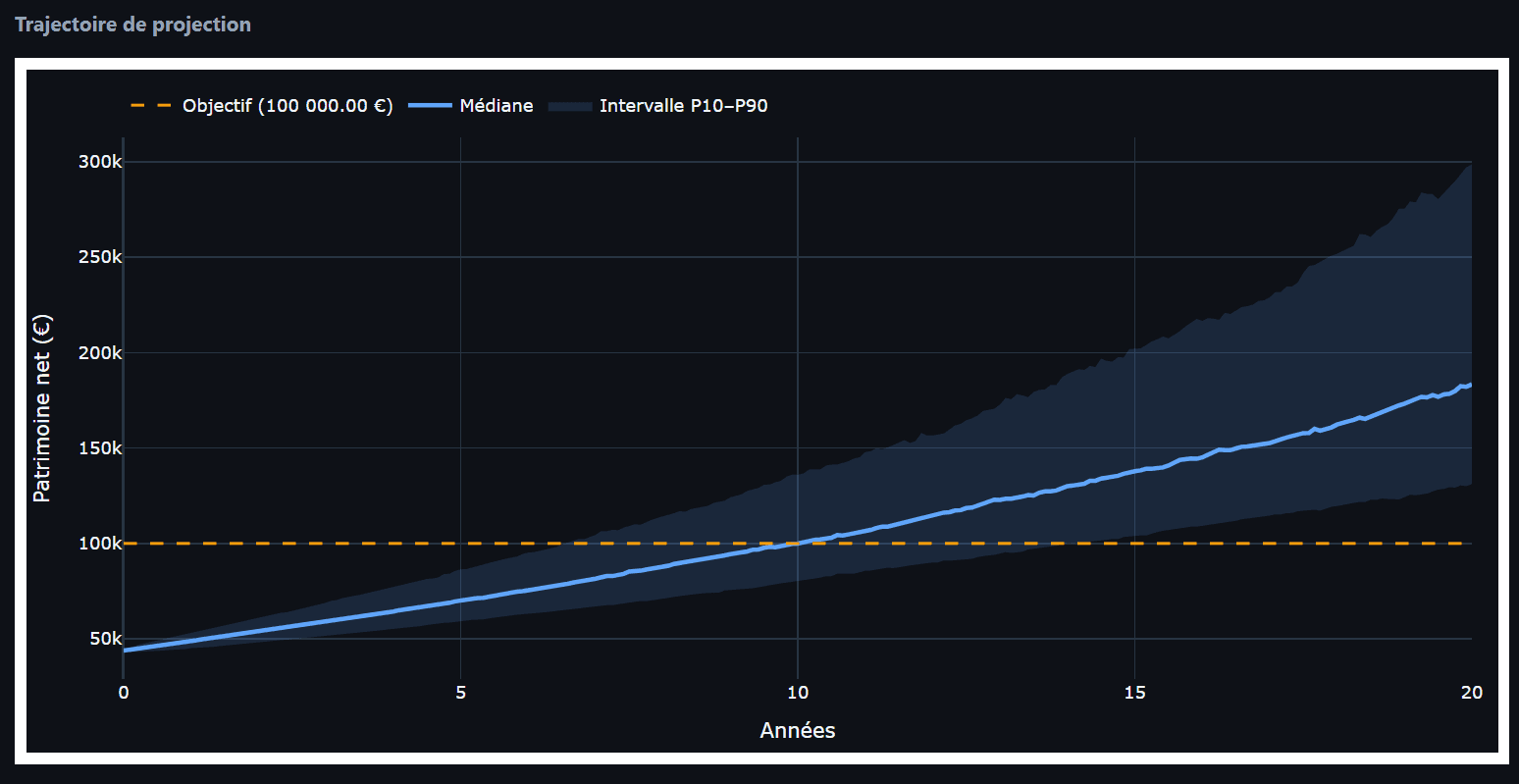
Scenario projection used to simulate portfolio paths over time.
Architecture
Versioned SQLite database with SQL migrations, transaction/account/asset/price/snapshot tables, plus import-alias tables to make reconciliations more reliable.
Dedicated modules for CRUD repositories, individual and household snapshots, consolidated income, advanced equity analytics, and weekly FX conversions.
Trade Republic CSV import pipeline with preview, ISIN and symbol resolution, canonical mapping, validation, and insertion.
Qt panels organized by business use case such as global wealth, listed assets, income, and data health, with Plotly rendering and rebuild actions.
Pipeline
Technical choices
Returns are computed after neutralizing weekly purchases and sales so that capital injections are not confused with actual investment performance.
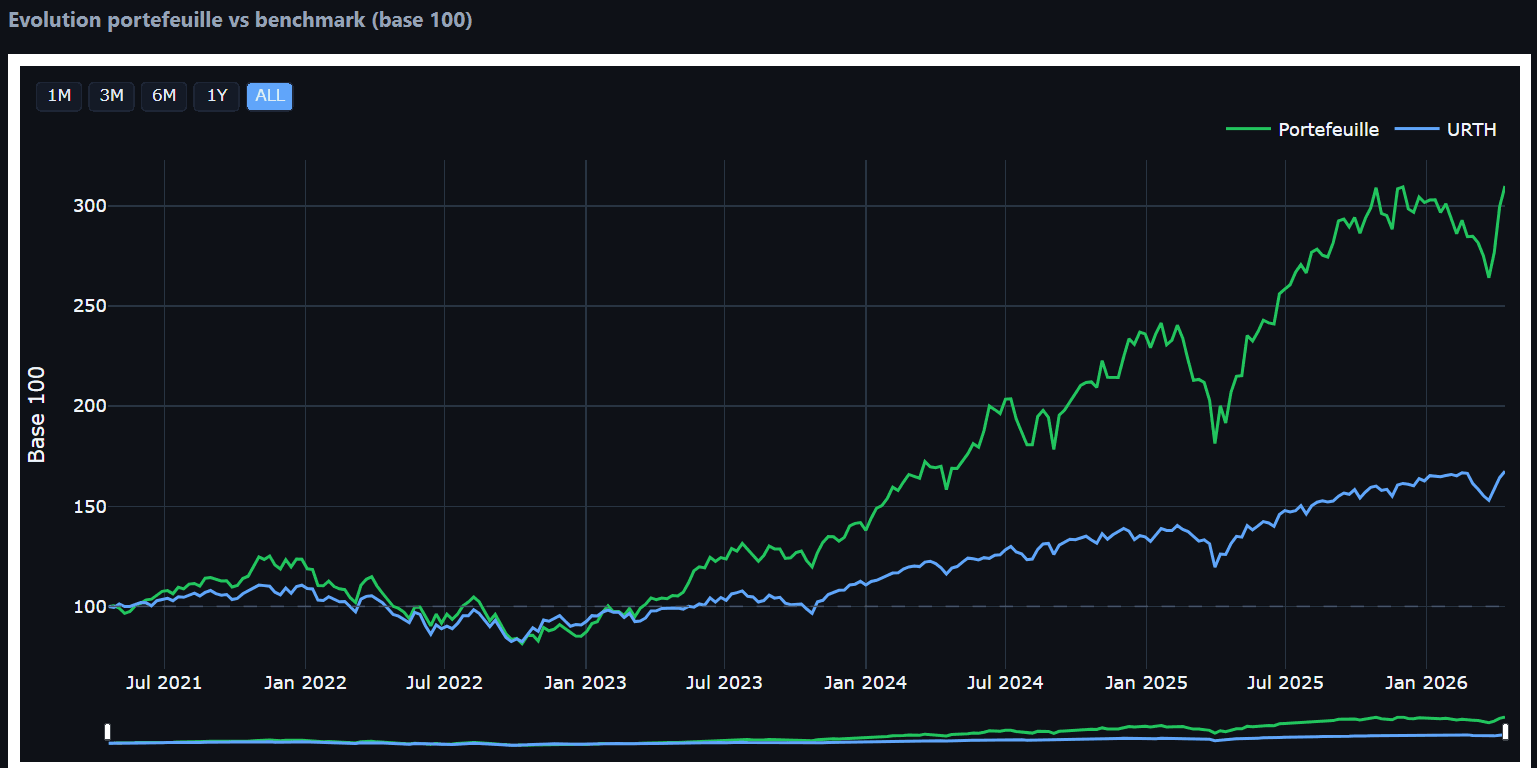
Annualized volatility, Sharpe ratio, beta versus URTH, and max drawdown are all computed from a coherent weekly time series.
The snapshot engine supports complete historical reconstruction, which is essential when older transactions are corrected or inserted later.
A preview of ticker, price, and currency reduces mapping risk before anything is inserted into the database.
Reliability
Limitations
Roadmap
Challenges
Model heterogeneous transactions such as buys, sells, dividends, interest, deposits, and withdrawals while preserving multi-account accounting consistency.
Compute truly usable returns by neutralizing weekly cash flows instead of relying only on raw valuation changes.
Handle real Trade Republic imports with ISIN or symbol mapping, alias management, edge cases, and WAF-token constraints without breaking existing history.
Support a full household snapshot rebuild from the first transaction onward, with progress tracking, cancellation, and quality checks.
Outcomes and learnings
Weekly snapshot engine for both individual and household views, with full historical rebuild capability.
Advanced portfolio metrics including annualized performance, volatility, Sharpe, beta versus URTH, and max drawdown, all based on cash-flow-adjusted calculations.
Robust import flow for Trade Republic with asset aliases, live ticker preview, and validation before insertion.
Test coverage on critical building blocks such as analytics, alias mappings, passive-income logic, transactions, and new account types.
Other projects
Quantitative Finance · Analysis · Python
Python environment to backtest strategies, compare risk and return metrics, and analyze portfolio behavior.
View this project
Quantitative Finance · C++ · Pricing
Group project in C++ to price several option types, including European, American, and Asian contracts, with CRR, Black-Scholes, and Monte Carlo.
View this projectDiscuss
If this project is relevant for you, I can detail the initial need, data structure, assumptions, challenges encountered, and analysis limitations.